Global Microbrand Watch Manufacturer

 Foksy Watches
  2026-09-04


Mention watch quality, many consumers and brand buyers first think of the origin.
"Is it necessarily better if it's made in Europe?"
"Is Chinese manufacturing only suitable for low-priced products?"
In fact, such a judgment has become increasingly difficult to accurately reflect today's watch manufacturing industry. What really determines the quality of a watch is not the words "Made in China" or "Made in Europe", but the material standards, parts precision, engineering design, assembly level, testing system and quality control behind it.
This is also the most important point when understanding "quality Chinese watches": Don't just compare the place of origin, but the manufacturing standards.
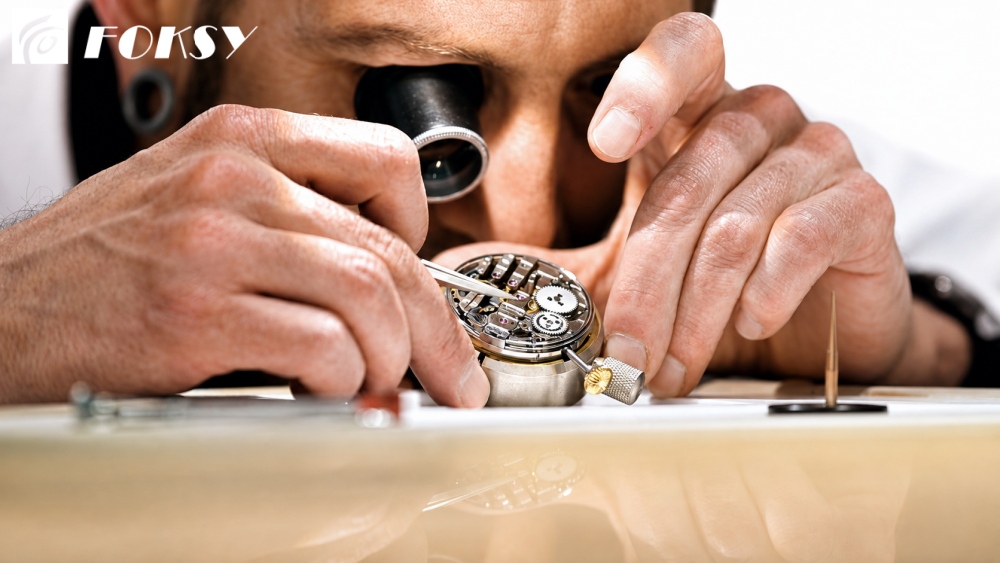
Europe, and especially Switzerland, has a centenarian watchmaking tradition dating back to the 16th century, followed by a gradually developed system of specialized parts supply, assembly and watchmaking, and a strong brand value in the field of mechanical watches, advanced complex functions and luxury watches.
China's modern watch manufacturing began to establish a large-scale watch industry in the 1950s, and then gradually developed a complete manufacturing supply chain for movements, cases, dials, Pointers, watch bands and finished watches.
Therefore, the development paths of the two are different.
While Europe has accumulated fine watchmaking tradition and brand value earlier, Made in China has grown rapidly in terms of scale production, supply chain integration, speed of product development, and manufacturing capabilities in different price ranges.
If the brand names are temporarily removed and only the watch itself is considered, the aspects that are more worthy of comparison are:
|
Comparison Item |
Chinese Watches |
European Watches |
|---|---|---|
|
Product Coverage |
Wide range from entry-level to high-end, broad style selection |
Strong presence in mid-to-high-end and luxury brands |
|
Supply Chain |
Concentrated parts supply, fast development cycle |
Mature professional supply system, some advanced craftsmanship excels |
|
Cost Efficiency |
Significant advantages in scale and procurement |
Labor and manufacturing costs are generally higher |
|
Movement Options |
Multiple options: Chinese, Japanese, Swiss, etc. |
Swiss and European movements widely used |
|
Final Quality |
Depends on materials, craftsmanship, and QC standards |
Also depends on materials, craftsmanship, and QC standards |
So, "Made in China" or "Made in Europe" themselves cannot fully represent the quality of the product.
The core of good quality Chinese watches is not because it comes from China, but whether the factory has produced it according to sufficient high standards.
There is a premise here: comparable materials must be used and comparable or even stricter production standards enforced.
On this basis, Chinese watches do not have a natural performance limit.
The waterproof performance of a watch will not automatically be higher just because it is produced in Europe; the stability of timekeeping will not automatically deteriorate just because the case is from China.
It's the engineering and manufacturing controls that really determine the outcome.
For instance, if the same 10ATM waterproof structure is used, and the design, structure, case back assembly and waterproof testing standards are the same, Chinese factories can definitely achieve the same level of waterproof performance.
Even in some projects, Chinese factories with mature equipment, engineering teams, and strict QC systems may also achieve more stable production consistency compared to some smaller and lower-standard factories in other regions.
So looking for the best quality Chinese watches is really looking for Chinese suppliers that enforce higher manufacturing standards, rather than simply looking for "watches made in China".
One obvious advantage of the Chinese watch industry is the centralized supply chain.
A watch project involves a large number of parts such as movement, case, dial, glass, pointer, crown, strap, electroplating and packaging.
When these suppliers are concentrated in mature manufacturing areas, factories can complete prototyping, modification, and procurement more quickly.
This supply chain advantage can reduce:
• Transportation time for parts;
• Multiple procurement costs;
• Discussion time for development;
• Production sample costs in small batches;
• Supply coordination costs in large-scale production.
Higher production efficiency and more competitive prices - a low-cost promotional watch and a high-specification OEM mechanical watch could both come from China, but their materials, craftsmanship, testing requirements and costs are completely different.
This is why one cannot use the cheapest Chinese watches to represent the entire Chinese manufacturing industry and then directly compare them with European high-end brands.
If you are looking for a watch manufacturer, we will sincerely assist you.
Europe has a deep watchmaking tradition, which is its long-term accumulation of advantages; China has a mature, complete and efficient watch supply chain.
The two are not simply a relationship of "high quality" and "low quality".
Real quality Chinese watches come from good materials, mature engineering design, stable production processes and strict quality control - these standards are also the same as any high-quality European watch must have.
FOKSY since 2006 engaged in watch manufacture located in shenzhen, China, long-term and quartz watch, mechanical watch for overseas brands and OEM/ODM custom services.
To judge whether a watch is good or not, first look at how it is manufactured, and then look at where it comes from.


Focus On Customize Watches
For Micro Brands
Room C201, Huafeng Wisdom Innovate Park, Gushu 2nd Road, Bao'an Dist, Shenzhen, China.