Global Microbrand Watch Manufacturer

 Foksy Watches
  2026-08-12


Recently, FOKSY received a product after-sales statistics report compiled by a long-term customer.
This is not a lab test, nor is it a sample picked out by the factory itself, but the data collected by the customer based on the actual after-sales situation after the product has actually entered the market and been worn by consumers.
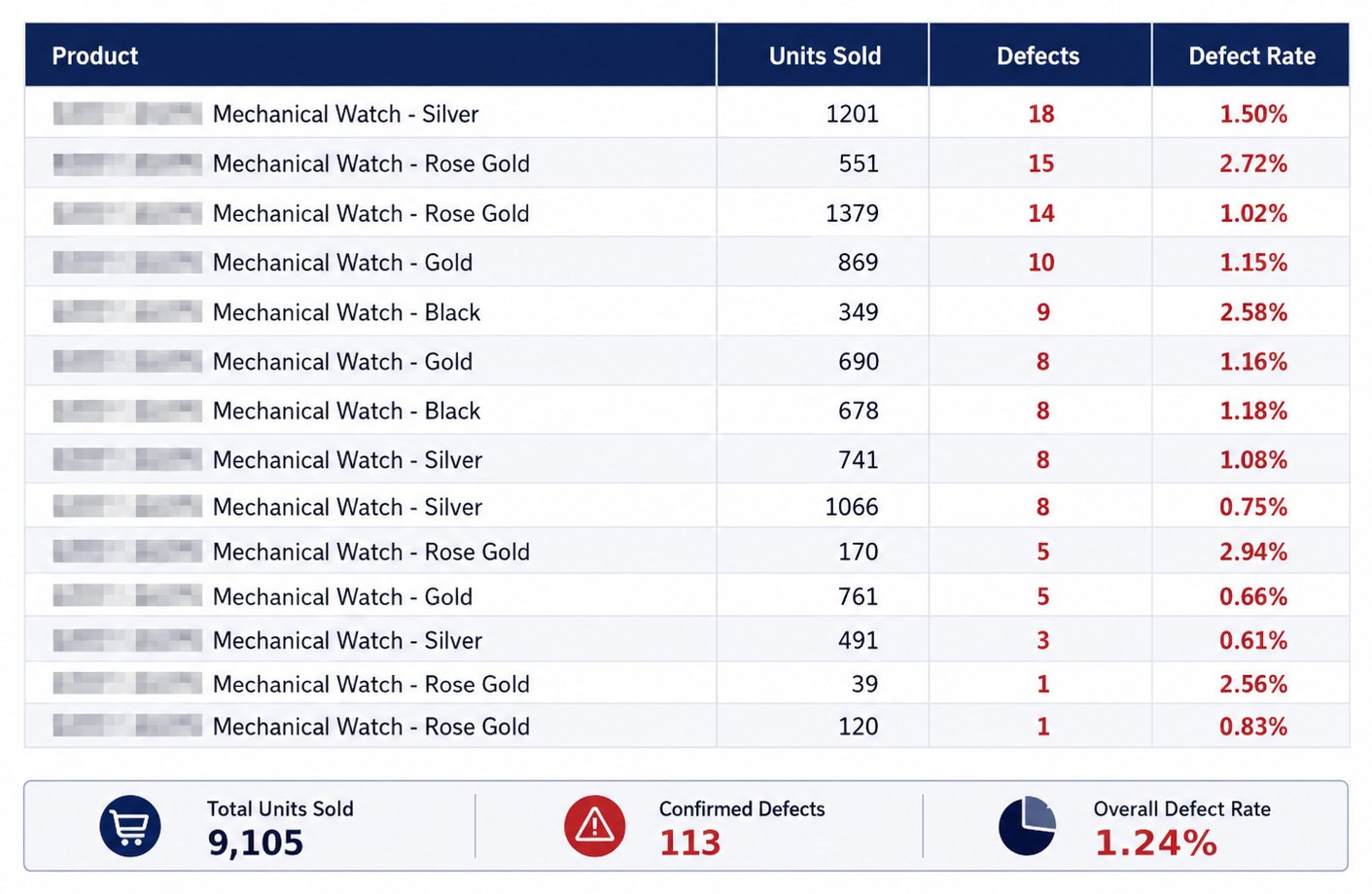
From the 14 mechanical watch SKUs shown in the graph:
• Total sales volume is approximately 9,105 units
• The number of confirmed problems is 113 units
• The overall after-sales rate is approximately 1.24%
• The after-sales rates of most SKUs are concentrated between 0.61% and 1.50%
• A few styles are affected by structure, design, or other factors, with after-sales rates exceeding 2%
For the use of Chinese mechanical movement, at the same time need to maintain a competitive price of products, this set of data than simply say "FOKSY quality is very good" is worth discussing, because the real mechanical watch quality, never just look at the movement brand, but to see whether the whole manufacturing system can make the product stable.
Consumers see is a complete watch, but from the point of view of manufacturing, mechanical watch internal by a large number of continuous movement of parts work together: balance wheel, escapement system, gear, spring, automatic tuo and other structures must maintain a stable cooperation. Any slight deviation may be manifested as too fast or too slow walking, stopping, insufficient power storage, reduced efficiency of automatic chain winding, pointer interference or abnormal fit of handle shaft.
This is one of the biggest differences between mechanical watches and ordinary quartz watches.
Quartz watches rely on electronic oscillations to keep time, while mechanical watches are themselves a set of continuously operating mechanical systems. The real difficulty in making mechanical watches, therefore, is not just "assembly done", but how to control the differences between each finished piece.
Higher prices and better factory consistency of the movement, of course, can reduce some of the difficulty of manufacturing, but for the cost advantage of Chinese mechanical movement, manufacturers need to invest more screening, testing and tuning work, because it is not the default that every movement is taken out of the packaging in the same state.
In the actual production process, the more important steps are: screening → testing → adjustment → assembly → re-testing
Through these steps, the individual differences between the movement control in a reasonable range, when the brand procurement of mechanical watches, only focus on what movement is not enough, should also pay further attention to these problems: movement into the factory has no screening? How was it tested before and after assembly? After discovering time deviation, was it adjusted?
These problems are often more indicative of the final mechanical watch quality than the movement names themselves.
This set of 9105 watches data does not show that mechanical watches can do "retail", in fact, any mechanical product is difficult to achieve absolute zero failure.
Its real value lies in reflecting the results of actual use in the market.
The total sales of the 14 SKUs is approximately 9,105 units, with 113 confirmed problems, and the overall after-sales rate is approximately 1.24%. Most SKUs can maintain the range of 0.61%-1.50%, which also shows that even if the Chinese mechanical movement with price advantage is adopted, the product stability can still be controlled at a good level through reasonable screening, adjustment, assembly and testing.
At the same time, some SKUs more than 2% performance also reminds FOKSY: mechanical watch quality is not only determined by the movement.
Case structure, pointer design, crown and handle shaft fit, assembly difficulty, and even the use environment of different styles may affect the final after-sales result.
A truly mature quality management should analyze the specific problems of each SKU, rather than just looking at the overall average value of the factory.
If you are developing your first mechanical watch, it is not recommended to only compare the movement model and unit price, for brand procurement, the real need to pay attention to is: can the manufacturer turn the individual differences of the movement itself into controllable, stable, sustainable replication of the watch quality.
It is not difficult to make a good sample. What is really difficult is to produce 100, 500 or even thousands of samples and still control the quality fluctuation within a reasonable range. This is also one of the core values FOKSY can provide to brand customers. Based on long-term mechanical watch production experience, we not only focus on which movement to use, but also pay attention to movement screening, assembly control, timekeeping testing, finished watch testing, and after-sales problem feedback. Through continuous watch quality testing and production data analysis, we help customers find potential risks before mass production, control quality fluctuations in the mass production process, and establish a more stable quality foundation for subsequent orders, thereby reducing after-sales costs and brand risks.
From the perspective of the real after-sales data of 9105 products only, is not only a recognition of FOKSY, more decision makers by experience, technical personnel, production management and continuous watch quality testing, each individual differences of mechanical movement, into a stable end product as soon as possible.
This is where a brand should truly focus when purchasing mechanical watches when developing a new mechanical watch project. If you are developing a new mechanical watch project, find out how FOKSY does movement screening, mass production quality control and table formation testing before confirming the price - contact us and tell us about your design, target movement or quality requirements, and we can help you reduce the risk of mass production from the sample stage.


Focus On Customize Watches
For Micro Brands
Room C201, Huafeng Wisdom Innovate Park, Gushu 2nd Road, Bao'an Dist, Shenzhen, China.