Global Microbrand Watch Manufacturer
 Foksy Watches
  2025-11-04


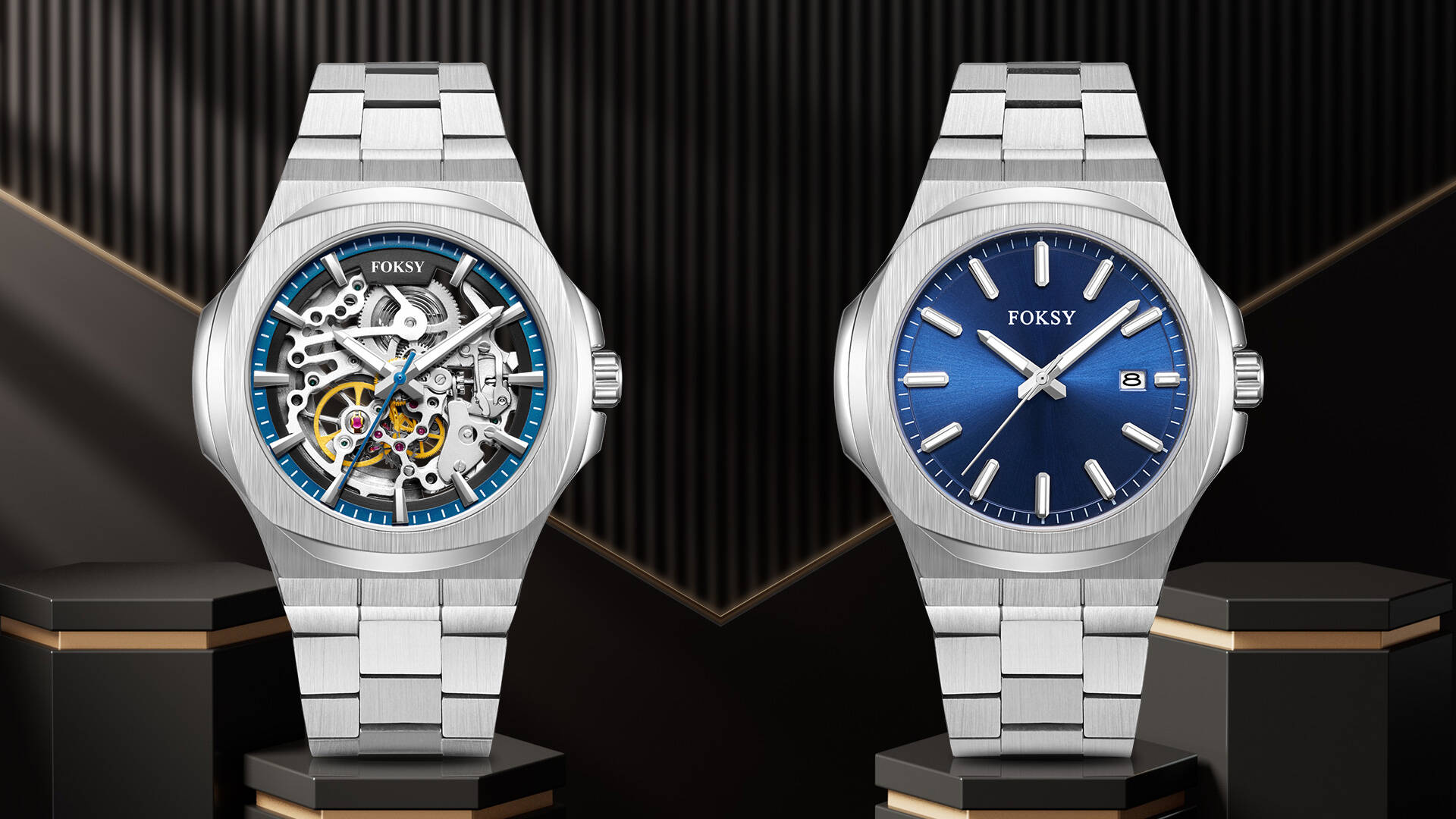
For B2B stakeholders—including watch retailers, corporate gifting distributors, industrial suppliers, and cross-border procurement managers—grasping the distinction between mechanical and quartz watches is pivotal to optimizing inventory, aligning with market demand, and safeguarding profit margins. This guide integrates key industry data to unpack technical and commercial variances, paired with actionable B2B use cases.
The gap between mechanical and quartz watches directly impacts supply chain strategy, cost structures, and customer value propositions. Below is a data-backed comparison tailored to B2B decision-making:
|
Dimension |
Mechanical Watches |
Quartz Watches |
|
Movement (Core Component) |
Spring-driven mechanism (mainspring + balance wheel) requiring artisanal assembly. Relies on precision parts like escapements and gears—often hand-finished by specialists. |
Battery-powered, with a quartz crystal vibrating at 32,768 Hz to regulate time. Most are mass-produced, though premium models (e.g., Grand Seiko 9F) use manual assembly. |
|
Accuracy |
±5–10 seconds/day for standard models; ±4–6 seconds/day for Swiss chronometers. Requires annual calibration. |
±10–20 seconds/month for mainstream models; premium quartz (9F) achieves ±5 seconds/month with zero frequent adjustment. |
|
Cost Structure |
- B2B procurement: 55–10,000+/unit (bulk). - Inventory risk: Slow turnover (3000 CHF+ segment grows 1%, while <3000 CHF drops 15.6% [1]). |
- B2B procurement: 5.4–500/unit (bulk). - Inventory efficiency: Fast sell-through (80% of global watch volume [1]). |
|
Maintenance & After-Sales |
- Servicing: Every 3–5 years, 150–2,200/unit (e.g., Audemars Piguet self-winding: 950 CHF [2]). - Repairs: Needs certified technicians (limited network). |
- Servicing: Battery replacement every 1–2 years, 5–50/unit. - Repairs: Low-cost, widely accessible via global service networks. |
|
Supply Chain Resilience |
- Dependent on niche manufacturers (Swiss ETA, Seiko Mechanical). - Lead time: 4–12 weeks (bulk orders). |
- Global supply: 70% from China/Vietnam [3]. - Lead time: 2–4 weeks (bulk orders). |
Matching watch type to end-user needs drives B2B success. Below are high-impact deployment strategies:
1. Mechanical Watches: Ideal for luxury channels (boutiques, high-end department stores). Leverage "craftsmanship narrative" to command 30–50% margins, targeting HNWIs in Europe/North America. Prioritize models above 3000 CHF to avoid declining entry-level segments [1].
2. Quartz Watches: Perfect for mass-market (supermarkets, Amazon Business). Low upfront costs (5.4–38/unit) and 31.8% projected online penetration by 2026 [3] drive high turnover in emerging markets.
1. Mechanical Watches: Use for executive rewards or VIP client gifts. Brands like Audemars Piguet position them as "status assets," aligning with finance/luxury industries. Custom engravings boost brand recall (30% higher client retention).
2. Quartz Watches: Opt for employee gifts or trade show swag. MOQs as low as 1 unit enable bulk orders (100+ units) for telecoms/banks, with branded straps costing 280–700/assortment.
1. Mechanical Watches: Suited for heritage brands (luxury automotive, jewelry). Pair with sapphire glass or alligator straps (450–700 CHF) to emphasize "timeless value" in marketing.
2. Quartz Watches: Dominant in sports/healthcare. Shockproof and waterproof models (5.4–650/unit) meet EU RoHS standards, ideal for medical staff or outdoor gear collaborations.
1. Mechanical Watches: Focus on Europe/U.S. (U.S. market size: $124.4 million in 2023). Factor in 10–20% import duties on high-value components.
2. Quartz Watches: Target Southeast Asia/Africa. China's 70% local supply chain cuts logistics costs, while Vietnam's production capacity reduces lead times by 30% [3].
Use this checklist to align watch type with business objectives:
1. End-customer profile: HNWIs/collectors = mechanical; mass market = quartz.
2. Per-unit budget: <50 = quartz; >100 = mechanical.
3. Inventory turnover target: <90 days = quartz; >180 days = mechanical [1].
4. After-sales capacity: Limited resources = quartz; certified technicians = mechanical.
Mechanical watches serve as strategic assets for premium B2B segments, leveraging craftsmanship to drive high margins despite longer lead times. Quartz watches excel in scalability and cost-efficiency, dominating mass-market and functional use cases [1,3]. By integrating FHS market data [1] and supply chain insights [3], B2B clients can mitigate risk, optimize procurement, and build long-term customer loyalty.
[1] Fédération de l’Industrie Horlogère Suisse (FHS). (2025). Swiss Watch Exports in 2024. https://extranet.fhs.ch/file/7588/communique_240112_e.pdf
[2] Audemars Piguet. (2025). Service Prices for Mechanical & Quartz Watches. http://www.shurl.cc/9c741a4fa2e137187774a826d5ebc3df
[3] W. Harry Sharpe Research. (2024). 2024 Global Watches, Clocks, and Parts Products Markets (2030 Outlook). http://www.shurl.cc/903bf51defae45515a68133677b8b9c6


Focus On Customize Watches
For Micro Brands
Room C201, Huafeng Wisdom Innovate Park, Gushu 2nd Road, Bao'an Dist, Shenzhen, China.