Global Microbrand Watch Manufacturer
 Foksy Watches
  2025-11-12


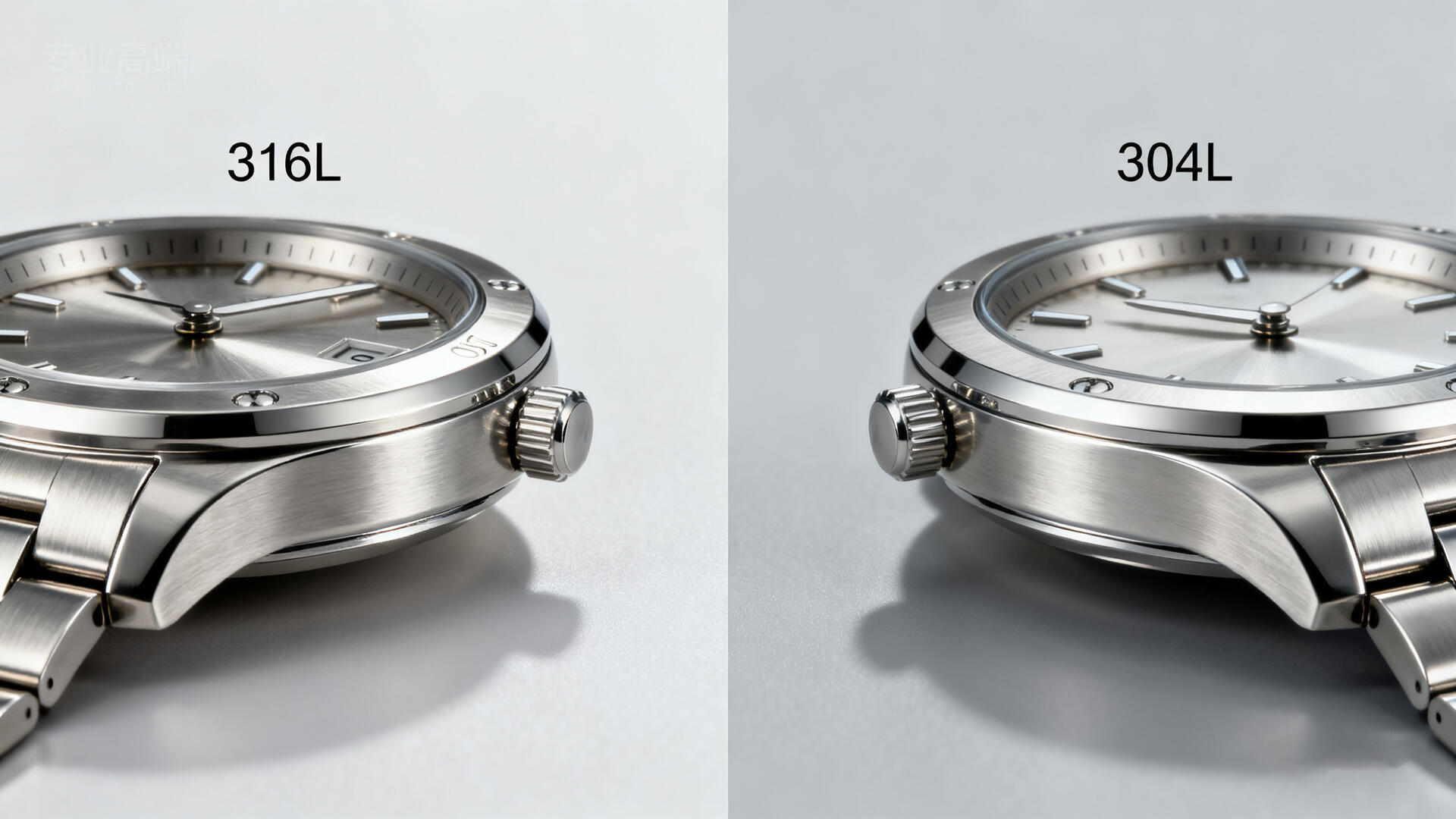
What factors should B2B watch manufacturers, component suppliers, and custom watch designers prioritize when selecting between 316L and 304 stainless steel for watch cases, bands, or intricate custom watch components? For the $28 billion global luxury watch market, the right steel choice directly impacts product durability, customer satisfaction, and profit margins—especially for brands specializing in custom watches. This guide breaks down the technical differences, application scenarios, and B2B-specific considerations to help you make informed decisions.
Both 316L and 304 are austenitic stainless steels, but their chemical compositions and properties differ significantly—critical for watch performance, especially in custom designs.
|
Trait |
316L Stainless Steel |
304 Stainless Steel |
|
Chromium Content |
16–18% (enhances corrosion resistance) |
18–20% |
|
Molybdenum Addition |
2–3% (boosts resistance to saltwater/chemicals) |
None |
|
Carbon Content |
≤0.03% (low-carbon, reduces brittleness) |
≤0.08% |
|
Common Watch Uses |
Cases, bands, diving watch components |
Budget watch cases, non-wearable parts |
For custom watches—where unique shapes and long-term wear resistance are key—316L's molybdenum content and low carbon level make it more adaptable to complex machining, such as curved custom watch cases or engraved bands.
B2B watch brands need steel that balances durability, processability, and cost—here's how 316L and 304 stack up:
316L outperforms 304 in harsh environments: it resists corrosion from sweat, saltwater, and skin oils—critical for watches worn daily or in marine settings. A 2024 industry test found 316L showed no rust after 1,000 hours of salt spray exposure, while 304 developed surface corrosion after 400 hours [1]. For custom watches marketed as "everyday luxury" or "sports-focused," 316L's corrosion resistance reduces post-purchase warranty claims.
316L has a Vickers hardness (HV) of 140–160, slightly lower than 304's 150–170. However, 316L's higher ductility means it's less prone to cracking during intricate machining—essential for custom watch details like laser-engraved dials or thin, curved case edges. 304, while harder, may chip if shaped into complex custom watch components [2].
Custom watch designs often require precise cutting, bending, or polishing. 316L's lower carbon content and molybdenum addition make it easier to form into unique shapes (e.g., oversized custom watch cases or integrated bands) without compromising structural integrity. 304, by contrast, can become work-hardened during repeated machining, increasing production time and costs for custom projects [3].
Your steel choice should align with your target market, product positioning, and custom watch design goals:
1. Use Cases: Luxury custom watches (priced $500+), diving custom watches (water resistance ≥100m), or custom watches for outdoor/active users. Brands like Tudor and Oris use 316L for their custom sports watch lines to emphasize durability.
2. B2B Benefit: Reduces returns due to corrosion or wear, enhancing brand reputation for custom watch quality.
1. Use Cases: Entry-level custom watches (priced 100–300), promotional custom watches, or custom watch components with minimal wear (e.g., inner case backs). Budget brands often use 304 for custom logo-engraved watches to keep costs low.
2. B2B Benefit: 15–20% lower material cost than 316L, ideal for high-volume custom watch orders or price-sensitive markets.
For B2B buyers, cost transparency and supply chain reliability matter as much as performance:
1. 316L Stainless Steel: 3.50–4.20 per kg (raw material); 8–12 per custom watch case (machined, polished).
2. 304 Stainless Steel: 2.80–3.30 per kg (raw material); 5–8 per custom watch case (machined, polished).
While 304 is cheaper, 316L's longer lifespan and lower warranty costs often offset the upfront price gap for premium custom watch brands.
1. Supplier Certification: Choose suppliers with ISO 9001 (quality) and ISO 14001 (sustainability) certifications—critical for custom watch brands targeting eco-conscious markets.
2. Minimum Order Quantities (MOQs): 316L suppliers typically require MOQs of 500+ kg for raw material, while 304 may have MOQs as low as 200 kg—better for small-batch custom watch production [4].
B2B brands must verify steel quality to avoid defects in custom watches. Key tests include:
1. Corrosion Test: Conduct salt spray testing (per ASTM B117) to confirm 316L's resistance or 304's suitability for its intended use.
2. Hardness Test: Use a Vickers hardness tester to ensure steel meets HV ranges for machining and wear.
3. Composition Analysis: Use X-ray fluorescence (XRF) to confirm chromium/molybdenum levels—critical for 316L's performance.
For B2B watch brands and custom watch designers, choosing between 316L and 304 stainless steel boils down to three factors: product positioning, custom design complexity, and target market needs. 316L is the clear choice for premium, durable custom watches where corrosion resistance and machining flexibility matter; 304 works for budget-friendly, simple custom watches or high-volume orders. By aligning steel choice with your B2B goals—whether it's building luxury custom watch lines or optimizing costs—you'll create products that stand out in a competitive market.
[1] International Stainless Steel Forum (ISSF). (2025). Stainless Steel Performance in Luxury Watch Applications.
Authority Note: Global trade association providing data on stainless steel corrosion resistance and industry standards.
[2] Swiss Watch Technology Institute (SWTI). (2025). Machinability of Stainless Steels for Custom Watch Components.
Authority Note: Leading institute specializing in watch material testing and custom manufacturing insights.
[3] McKinsey & Company. (2024). B2B Cost Benchmarks for Watch Manufacturing Materials.
Authority Note: Premier consulting firm offering data on raw material costs and market trends for luxury goods.
[4] Global Watch Suppliers Association (GWSA). (2025). Procurement Guidelines for Stainless Steel in Watchmaking.
Authority Note: Industry group providing B2B-specific tips on supplier selection and MOQ negotiations.


Focus On Customize Watches
For Micro Brands
Room C201, Huafeng Wisdom Innovate Park, Gushu 2nd Road, Bao'an Dist, Shenzhen, China.